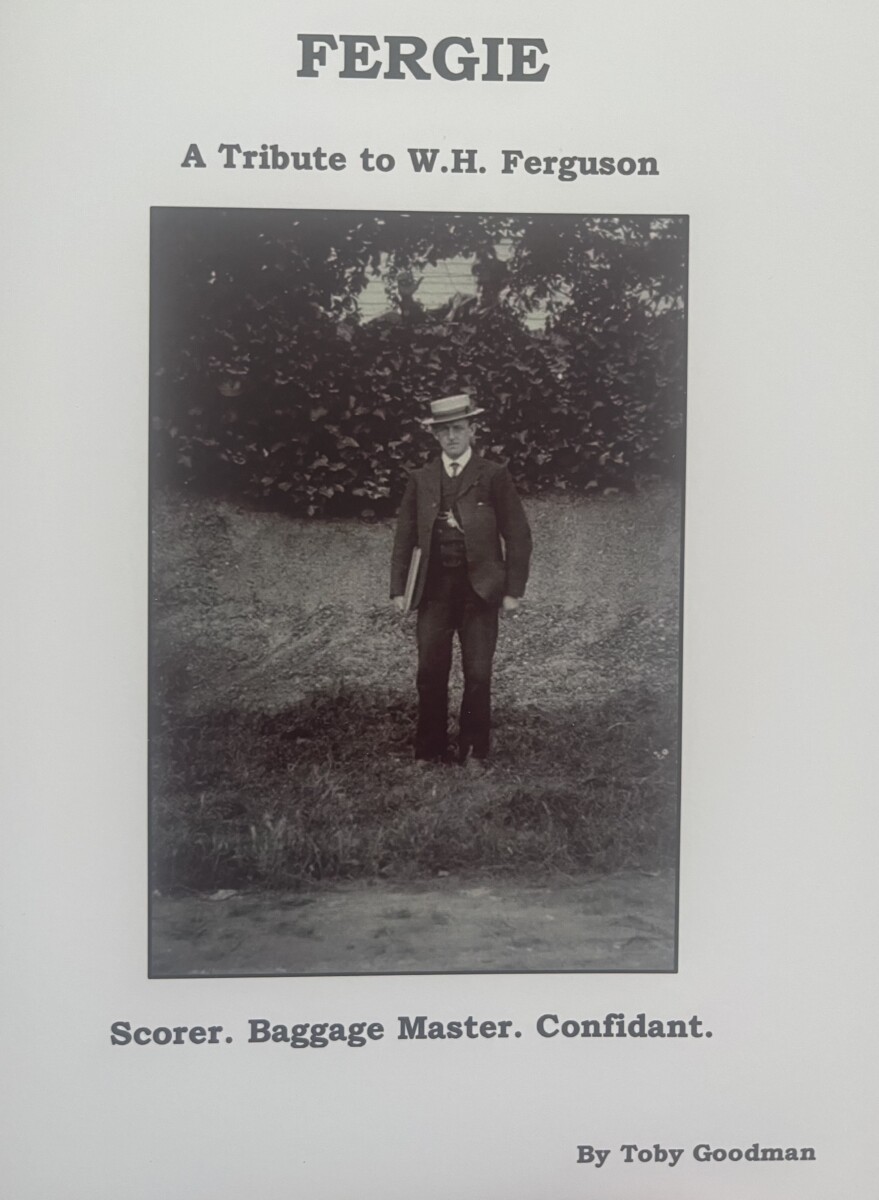
Soft covers, limited edition; signed by the author
1 review for Goodman, Toby – Fergie, a tribute to WH Ferguson
Ken –
Review by Gerry Wolstenholme:
When I first started following cricket, Fergie was a name quickly known by me because he was spoken of as being the general factotum of any number of cricket touring teams to the United Kingdom. As the author mentions in his Foreword, ‘Bill Ferguson was much more than a scorer. He was a completely reliable organiser and “go-to”, a baggage man, a tour guide, everyone’s solid support and valued confidant.’ And this book records details of all those virtues.
Born in Dunedin, New Zealand, his parents John and Mary Ann married in Southport, Lancashire, England, and emigrated originally to New Zealand from where they moved to Sydney, Australia, where Fergie’s six siblings were born; one of them, the youngest, Nellie, later married the Australian cricket captain Monty Noble.
He originally worked as a filing clerk, an occupation he later described as ‘one of the most monotonous occupations known to man’. However, he was always passionate about cricket and one of his earliest memories was watching the English batsman R.E. ‘Tip’ Foster making his Test debut in 1903 and making a record score of 287.
While he was at that game in Sydney he heard about a nephew of S.E. Gregory who had worked as a baggageman and scorer during Australia’s tour of England the year before. He at one made his mind up that this was a job he would love and with Australia due to tour England again in 1905 he was determined to put himself in the frame for the role as scorer.
In due course he received a letter from Australia’s player-manager Frank Laver informing him that he had been selected to be appointed, at a salary of £2 per week, to ‘look after the baggage etc while the tourists were in England. With his only experience as a scorer being for his church league team, Laver gave him a scorebook and explained what was required. And thus began his extraordinary career.
From then on he travelled with every Australian team to England until 1953. On his first tour he watched WG Grace score 162 for Gentlemen of England at Crystal Palace and reminiscing later he said, ‘Grace was an immense exuberant individual who used to talk a lot and kicked up a lot of noise with his laughing.’
He saw all the great players of his day and, indeed, he scored every Test innings of Don Bradman. And in doing so he was an innovator in that he pioneered the run-scoring wheel on which the direction of every scoring shot was charted and which became a staple requirement for coaches when they analysed the strengths and weaknesses of every batsman that they were likely to encounter. [On a personal note I scored every ball of the 1961 Ashes Test at Old Trafford in 1961, both all in one chart and in a variety of charts showing strokes off each bowler the batsman faced [ where it eventually got to I know not, a pity I would love to have seen it today!]
His only breaks in his career came when war intervened in 1914 and again when he was scoring the West Indies’ tour of the UK in 1939 when war came along again. And he remained in England and worked in the War Office. One memory of the latter he recalled was, ‘We had a terrible time with the bombings and were blasted out of our office twice.’
In the 1952 New Year’s honours list he was rewarded the British Empire Medal for services to cricket. And, having seem many great players over a number of decades when asked in 1957 about his all-time World XI he selected, Noble, Bradman, Trumper, Hammond, Hobbs, Hutton, Rhodes, Grimmett, Larwood, McDonald and Oldfield. He also noted others facts in 1954; Best innings, Charlie Macartney’s 151 for Australia v England at Leeds in 1926; Most exciting match, Australia’s chase of 336 v South Africa at Durban in 1950 when, after being bowled out for 75 in the first innings, Australia, with Neil Harvey 151 not out seeing his side to victory; Greatest batsman, Don Bradman; Greatest fast bowler, Ted McDonald, just ahead of Harold Larwood [both with Blackpool connections!]; Best left-handed bowler, Wilfred Rhodes; Best fielders, Jack Gregory and Percy Chapman.
Fergie died at his home in Bath on 22 September 1957, aged 77 when New Zealand cricket writer Dick Brittenden praised him with ‘He has written, in his neat little hand, a permanent place for himself in the story of the summer game.’
His like will never be seen again and this delightful book pays glorious tribute to him.

Ken –
Review by Gerry Wolstenholme:
When I first started following cricket, Fergie was a name quickly known by me because he was spoken of as being the general factotum of any number of cricket touring teams to the United Kingdom. As the author mentions in his Foreword, ‘Bill Ferguson was much more than a scorer. He was a completely reliable organiser and “go-to”, a baggage man, a tour guide, everyone’s solid support and valued confidant.’ And this book records details of all those virtues.
Born in Dunedin, New Zealand, his parents John and Mary Ann married in Southport, Lancashire, England, and emigrated originally to New Zealand from where they moved to Sydney, Australia, where Fergie’s six siblings were born; one of them, the youngest, Nellie, later married the Australian cricket captain Monty Noble.
He originally worked as a filing clerk, an occupation he later described as ‘one of the most monotonous occupations known to man’. However, he was always passionate about cricket and one of his earliest memories was watching the English batsman R.E. ‘Tip’ Foster making his Test debut in 1903 and making a record score of 287.
While he was at that game in Sydney he heard about a nephew of S.E. Gregory who had worked as a baggageman and scorer during Australia’s tour of England the year before. He at one made his mind up that this was a job he would love and with Australia due to tour England again in 1905 he was determined to put himself in the frame for the role as scorer.
In due course he received a letter from Australia’s player-manager Frank Laver informing him that he had been selected to be appointed, at a salary of £2 per week, to ‘look after the baggage etc while the tourists were in England. With his only experience as a scorer being for his church league team, Laver gave him a scorebook and explained what was required. And thus began his extraordinary career.
From then on he travelled with every Australian team to England until 1953. On his first tour he watched WG Grace score 162 for Gentlemen of England at Crystal Palace and reminiscing later he said, ‘Grace was an immense exuberant individual who used to talk a lot and kicked up a lot of noise with his laughing.’
He saw all the great players of his day and, indeed, he scored every Test innings of Don Bradman. And in doing so he was an innovator in that he pioneered the run-scoring wheel on which the direction of every scoring shot was charted and which became a staple requirement for coaches when they analysed the strengths and weaknesses of every batsman that they were likely to encounter. [On a personal note I scored every ball of the 1961 Ashes Test at Old Trafford in 1961, both all in one chart and in a variety of charts showing strokes off each bowler the batsman faced [ where it eventually got to I know not, a pity I would love to have seen it today!]
His only breaks in his career came when war intervened in 1914 and again when he was scoring the West Indies’ tour of the UK in 1939 when war came along again. And he remained in England and worked in the War Office. One memory of the latter he recalled was, ‘We had a terrible time with the bombings and were blasted out of our office twice.’
In the 1952 New Year’s honours list he was rewarded the British Empire Medal for services to cricket. And, having seem many great players over a number of decades when asked in 1957 about his all-time World XI he selected, Noble, Bradman, Trumper, Hammond, Hobbs, Hutton, Rhodes, Grimmett, Larwood, McDonald and Oldfield. He also noted others facts in 1954; Best innings, Charlie Macartney’s 151 for Australia v England at Leeds in 1926; Most exciting match, Australia’s chase of 336 v South Africa at Durban in 1950 when, after being bowled out for 75 in the first innings, Australia, with Neil Harvey 151 not out seeing his side to victory; Greatest batsman, Don Bradman; Greatest fast bowler, Ted McDonald, just ahead of Harold Larwood [both with Blackpool connections!]; Best left-handed bowler, Wilfred Rhodes; Best fielders, Jack Gregory and Percy Chapman.
Fergie died at his home in Bath on 22 September 1957, aged 77 when New Zealand cricket writer Dick Brittenden praised him with ‘He has written, in his neat little hand, a permanent place for himself in the story of the summer game.’
His like will never be seen again and this delightful book pays glorious tribute to him.