Description
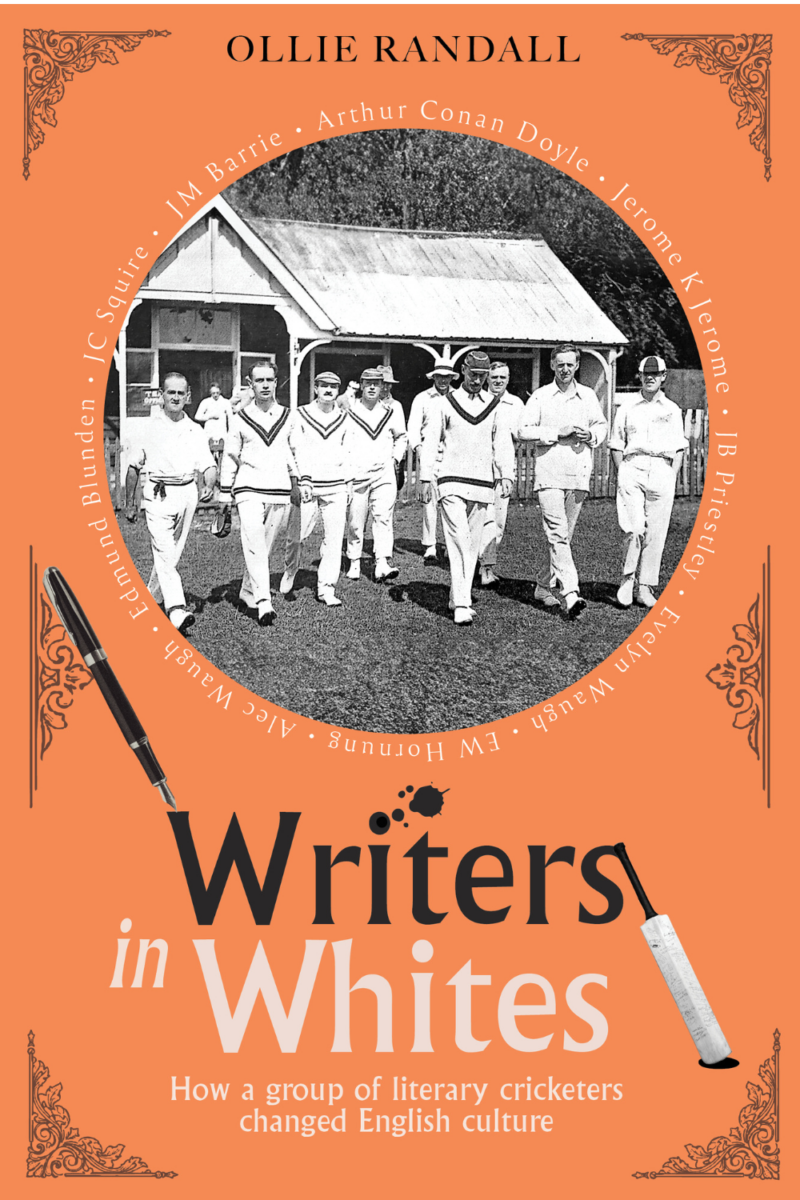
Writers in Whites, how a group of literary cricketers changed English culture is the story of cricket’s influential role in London’s literary world, from the 1880s to the 1960s. PG Wodehouse used his cricket-playing to launch his writing career. JM Barrie modelled the pirates in Peter Pan after his cricket teammates. Arthur Conan Doyle named Sherlock Holmes after a cricketer he’d played against. They all belonged to a network of cricket-playing writers, who collectively left a permanent legacy on English culture.
Their teams went by various names, but most often they called themselves the Authors. Based on a wealth of new research, Writers in Whites tells the story of this group, from Jerome K. Jerome via Evelyn Waugh to Michael Morpurgo. It wasn’t simply that lots of important writers happened to like playing cricket together. The very act of playing for the Authors influenced their careers and their writings – both through networking opportunities and by helping to shape their cultural outlook. The literary cricketers weathered scandals and ferocious culture wars, but they also wrote numerous memoirs describing their antics on and around the cricket field.
Writers in Whites draws on their books and unpublished letters, letting these men narrate, in their own words, how literary cricket played a key role in their lives. The full story – which provides a fresh way of viewing English cultural history from the 1880s to the 1960s – has never been told before. Literary cricket played a role in the rise of mass literature before the First World War, and in rallying resistance to the Modernists in interwar London. It also drew in some of the great names of twentieth-century Test cricket, such as CB Fry, Douglas Jardine, Learie Constantine, Len Hutton and Richie Benaud as well as cricket writers and reporters such as EV Lucas, Neville Cardus, EW Swanton and Henry Blofeld.
It is a quality hardback with dw. New


Ken –
Review: Ken Piesse
In 1900, a teenage, cricket-besotted PG Wodehouse penned his first stories for a fee, including this one, for the Public School [italics] Magazine: ‘The ambition of every human new-boy,’ he said, ‘is surely to become like J. Essop of the first XI, who can hit a ball over two ponds, a wood and seven villages rather than to resemble that pale young student Mill-Stuart who, though he can speak Sanscrit like a native of Sancritia, couldn’t score a single off a single long-hop.
‘Our bright young (Public School) kids are taught insane constructions in Greek and Latin from morning till night and they come for their holidays, in many cases, without the merest foundation of a batting style. Ask then what a Yorker is and they will say: “A man from York”.’
Wodehouse, one of the most vibrant and enduring of all comedic writers, was also among the keenest members of the much-loved, multi-talented Author’s XI which was also to include its patriarch Arthur Conan Doyle (famous for Sherlock Holmes) and fellow Scots AG Macdonell (author of [italics] England their England, the most irresistible of all cricket novels) and JM Barrie (the creator of Peter Pan).
Ollie Randall shares their enduring love of cricket, how Wodehouse despaired of working in a bank and instead indulged his love of the summer game, feverishly writing most nights until after midnight, honing and caressing and finally being published regularly thanks to an indulgent editor who also loved cricket.
Being part of the Author’s XI immediately allowed him into the inner sanctum of London’s most celebrated writers.
‘Wodehouse thrived at Dulwich College, where he’d been in first eleven,’ writes Randall, ‘and planned on going to Cambridge. Instead he was abruptly told over the summer holidays that his parents could no longer afford it.
So in September 1900, with his university dreams, dashed the forlorn 18-year-old Wodehouse began work – at his father’s instigation – at the Hong Kong and Shanghai Bank. He hated the job from the start and resolved to write his way out.’
Edinburgh-born Conan Doyle had attended an English boarding school, and cricket, by far, was the greatest of all his passions and on marrying in 1885, he went on a cricket tour rather than a honeymoon.
So successful were his Sherlock Holmes short stories that the circulation of London’s [italics on Strand] Strand Magazine was to peak at 300,000, an extraordinary readership for the time.
Unlike Wodehouse and Barrie who’d regularly write about cricket, Doyle merely used the names of cricketers as inspiration for his characters, Randall saying that 240 of 300 characters in his Sherlock Holmes stories, including Sherlock himself, were named after cricketers.
Tall and broad-of-chest – Randall describes him as ‘a big bear of a man’ – Doyle was a star player himself, captaining the Author’s XI for many years. He once took seven wickets in a club match at Lord’s and instituted Undershaw Cricket Week in Surrey, hosting a team of friends and playing local villages.
Randall says cricket allowed Doyle and others to leave ‘their Scottish identities at the boundary rope and became honorary Englishmen’.
[ita;ics]Writers in Whites is a sheer delight.